New AI Development at evosoft – Our next digital assistant is taking shape
Reliable, secure, smart, and designed to boost efficiency. Introducing our Knowledge Bridge AI‑based solution.
What is Knowledge Bridge? What is it good for?
Knowledge Bridge is evosoft’s new, self‑developed AI‑based solution: a framework that relies exclusively on Siemens resources. Using AI and a language model, it converts source files of various formats first into text, then into text chunks, and finally into vectors. All of this is done in a controlled manner, strictly in accordance with individual, user‑specific permissions.
And what is one of its major advantages? Instead of delivering generic answers sourced from the internet, Knowledge Bridge analyzes information within its own closed and secure system. In addition, it provides source references with every response, making the accuracy and reliability of the answers fully traceable and verifiable.
The original idea and its further development are linked to colleagues from evosoft’s Application Solution and Services area. The solution is currently available at company level. Among other things, you can ask about evosoft, Webcasts, our valid policies, and even projects.
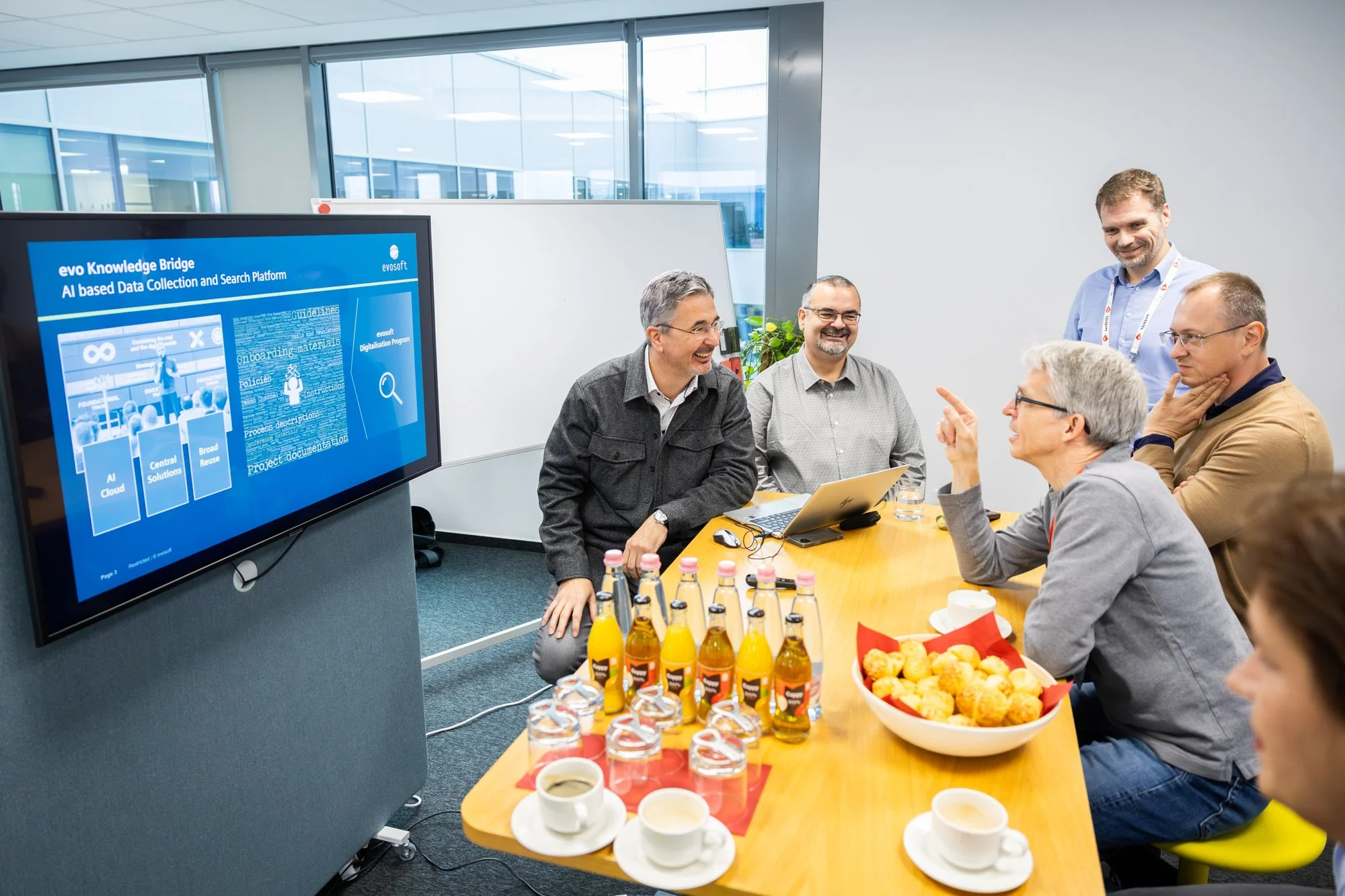
When did you realize that this solution was truly needed?
The first realization dates back to Dirk Didascalou’s visit last year. That was how a chatbot can be used to ask questions and how its answers can support our daily work. We saw that technology works, but it also highlighted a long-standing challenge: finding answers to rare, highly specific questions takes a great deal of time and significantly reduces efficiency.
A typical example is planning unpaid leave. There is a policy, but because it’s used so rarely, people often forget where to look for it. Knowledge Bridge helps here: it doesn’t expect a list of keywords, but “understands” what you mean and tailors the results accordingly.
Let’s look behind the scenes and the technology! How does Knowledge Bridge work?
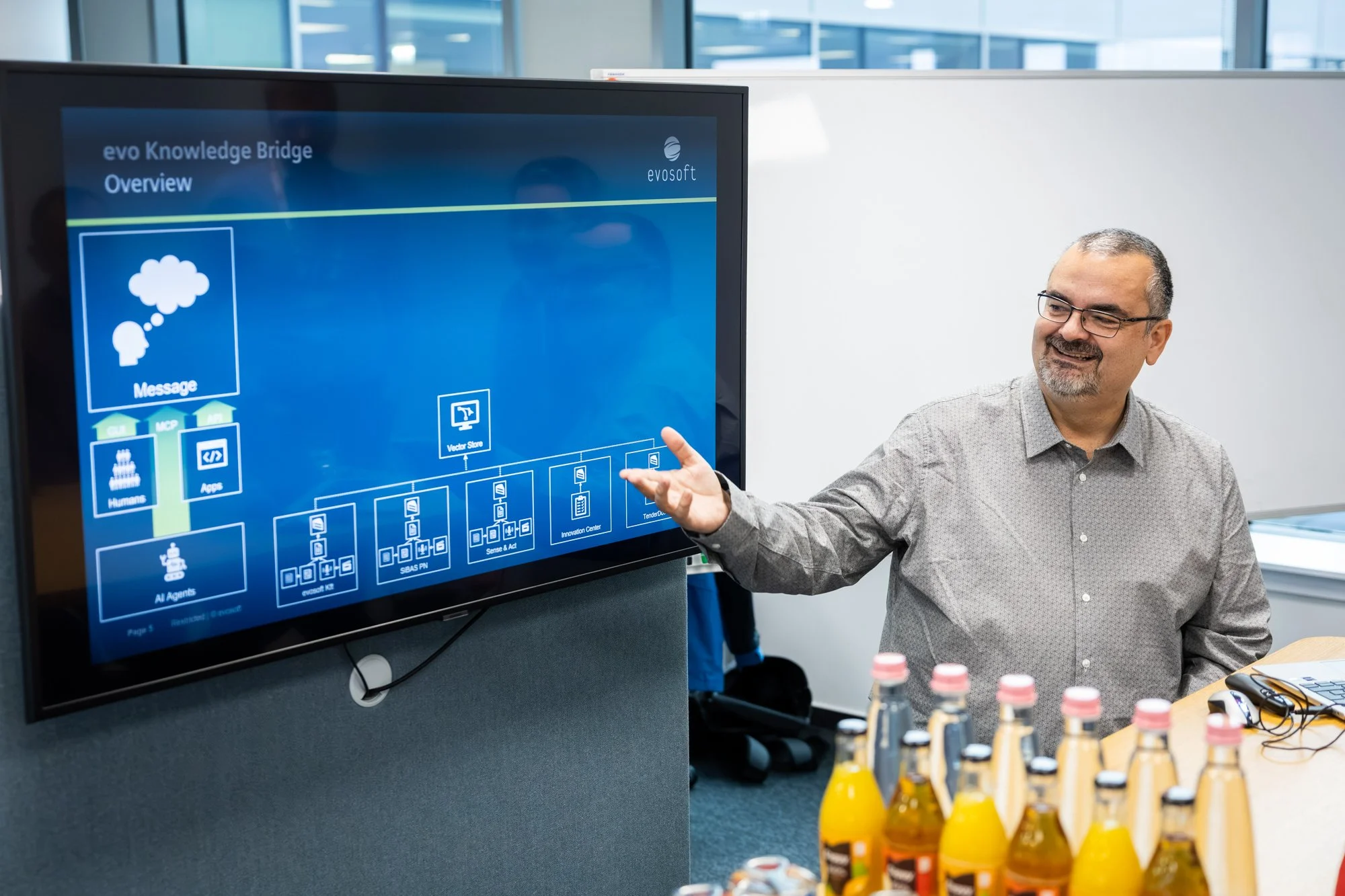
Knowledge Bridge converts every source into text, whether it is a PDF, spreadsheet, image, or even video. From videos we extract the audio and convert the audio into text; from images we generate a description (what can be seen on them).
Next, the material is broken down into meaningful, short text units, and vectors are created from these When you ask a question, your question is also converted into a vector, and the system searches the vector database for the text fragments that best match it. These relevant pieces are then passed to the language model, which generates the answer based specifically on evosoft’s own materials.
As a result, you do not receive generic, internet‑based answers, but information grounded in the company’s actual policies and projects. Each response includes source references, allowing you to navigate back to the original material and verify its authenticity if needed.
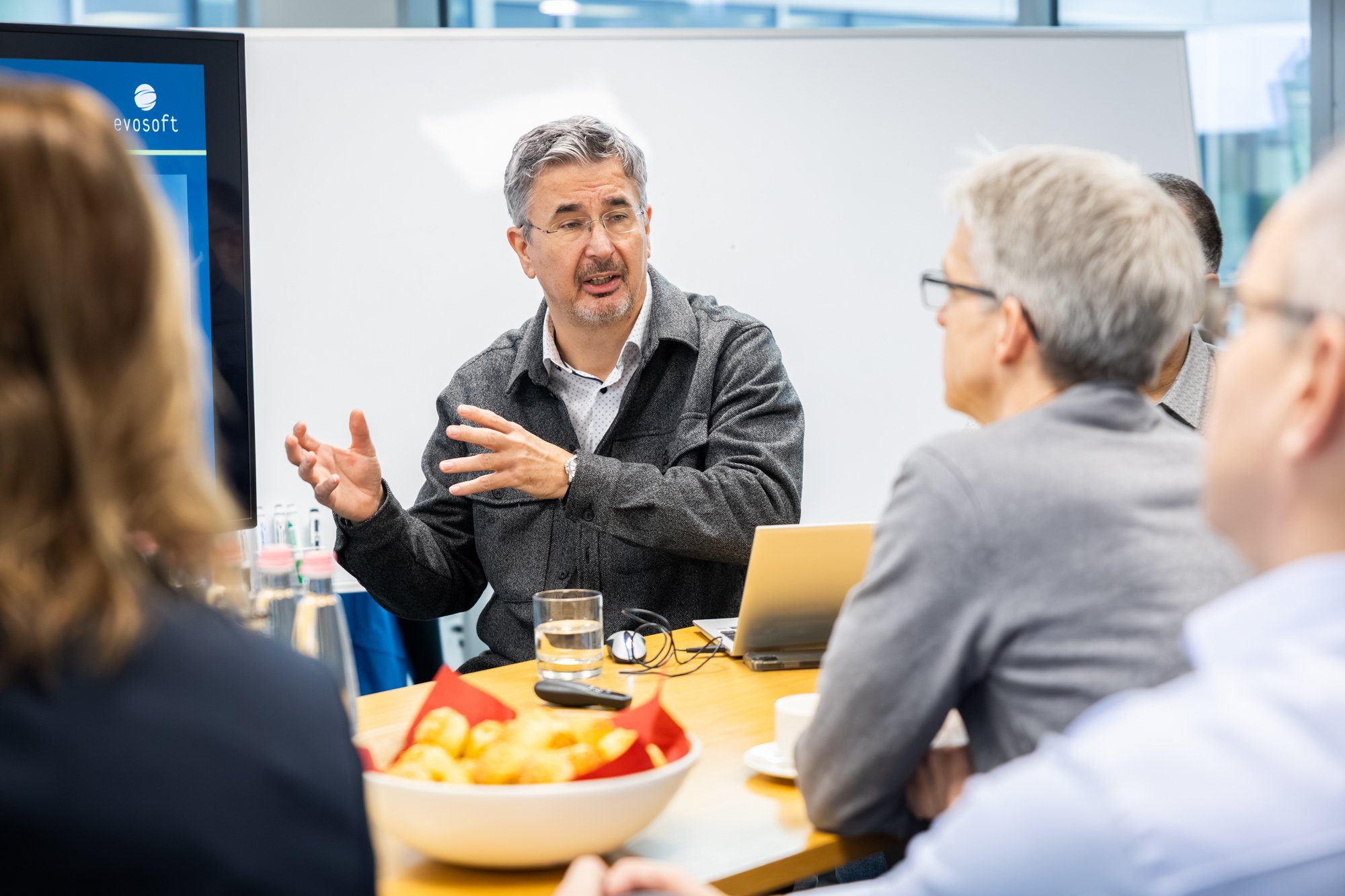
How do you ensure that the results are truly relevant while maintaining strict information security?
The technology behind Knowledge Bridge – and its operational model – remain strictly within Siemens. Additional security is ensured by comprehensive permission management. Information is organized into so‑called project‑ and topic‑specific collections, and all searches are performed exclusively within these scopes.
As a user, you only ever see answers from the collections for which you have permission. For example, if you have access to your project’s SharePoint, you will also be able to access the collection built from it in Knowledge Bridge. Without the appropriate permission, this access is not possible.
The separation of collections is particularly important for two fundamental reasons. First, it addresses the permission and information security requirements mentioned above: it allows precise regulation of who can access which data. Second – and in many cases, just as important – this separation ensures that large language models deliver relevant answers. If a model has to search across the entire corporate or internet knowledge space, there is a high risk that it will take completely irrelevant information into account, which can lead to distorted or inaccurate responses.
A good practical example is the case of the word Apple: it can refer either to the fruit or to the technology company. If content is not properly separated for the model, agricultural information may easily dominate instead of technology‑related knowledge.
This issue is common in any corporate environments: if you ask about a specific project at Siemens, you don’t want all projects or unrelated topics in return – you want knowledge relevant to that area. Therefore, separation is not only critical to restrict access, but also for maintaining relevance and precision.
It is equally important that the model searches within the appropriate knowledge domain and delivers truly relevant, accurate answers to the given question. This is also the foundation of Intelligent Routing: if desired, you can search across all collections you’re authorized to access, but not in a mixed manner or an uncontrolled way. Instead, searches are performed in a structured and controlled manner.
Why is Knowledge Bridge useful for the entire company – and for every project?
It’s unbeatable in two recurring situations.
First, when you’re searching for rarely used information in your project – something that typically takes a lot of time and reduces efficiency. Most of us don’t keep such details in mind, which is why finding them can be slow and frustrating.
Second, onboarding. When a new colleague joins, it is natural for them to have many questions, and Knowledge Bridge supports this process as well. New colleagues can access the project’s knowledge base collected in a single, secure, closed place, bringing together information from the wiki, SharePoint, TFS and various internal portals.
Where does Knowledge Bridge stand today in live use? Are teams already to apply it?
Yes – and this is perhaps the best news. Several projects, including teams in Miskolc, have already collected their documents, granted access, and had their materials processed by Knowledge Bridge. Onboarding is continuous, and with each new team joining, the searchable knowledge base and dataset grow significantly.
Knowledge Bridge has been developed – and continues to evolve – through close collaboration with evosoft colleagues and students. The solution has also attracted the interest of the scientific community: our partner, Óbuda University, would like to launch a joint research and development project with evosoft. We would provide them with a solution for research purposes and based on the university’s experience and feedback, we would further develop it internally. We are very happy about this initiative, which confirms our expectations that Knowledge Bridge is a technically strong, modern platform with significant potential recognized by academic institutions as well.
What are the next major steps?
We clearly see two main directions.
The first is the expansion of data sources. So far, SharePoint has been the primary channel, but integration with the intranet and individual websites is now underway. A recent success story is the import of content from the People & Organization intranet site into the database, which Knowledge Bridge is now actively processing and ‘reading’.
The second direction is Agentic AI. This means that, beyond answering the question, the bot will also be able to perform simple operations – while fully respecting permission and access controls.
Imagine typing: ‘I’m going on holiday next week.’ The bot would then automatically free up your desk, manage your parking place, cancel your meetings, and set your out‑of‑office message.
With this, we are truly moving toward a digital assistant, – one that not only brings you closer to knowledge but also reduces your daily administrative tasks.
And there is one more exciting aspect: Knowledge Bridge is already operating within several applications.
TenderDoc, for example, answers questions about Excel sheets by automatically recognizing the query, identifying the relevant answer location, and delegating the request to Knowledge Bridge via the evoKB API.
Without separation and knowledge‑based integration, this would be nothing more than a simple chatbot. By contrast, leveraging and reusing Siemens infrastructure enables the creation of a deeply integrable and cost‑effective solution.
Here, the language model isn’t only used for conversation – it’s a component that can also be embedded into applications. Visual Studio, for instance, can leverage our internal knowledge base for code completion: in a special MCP mode, GitHub Copilot calls agents that retrieve relevant information from the knowledge base. We’ve seen this in practice:
the agent recognized that the question could be answered from the knowledge base,
it queried the data, and
another model selected the most appropriate answer.
This creates an ecosystem in which the language model actively integrates into the Siemens environment – far beyond the scope of a traditional chatbot.